|
Statute : Arabic, English, French, German, Portuguese, Russian, Spanish
1st Congress: Cape Town 2009
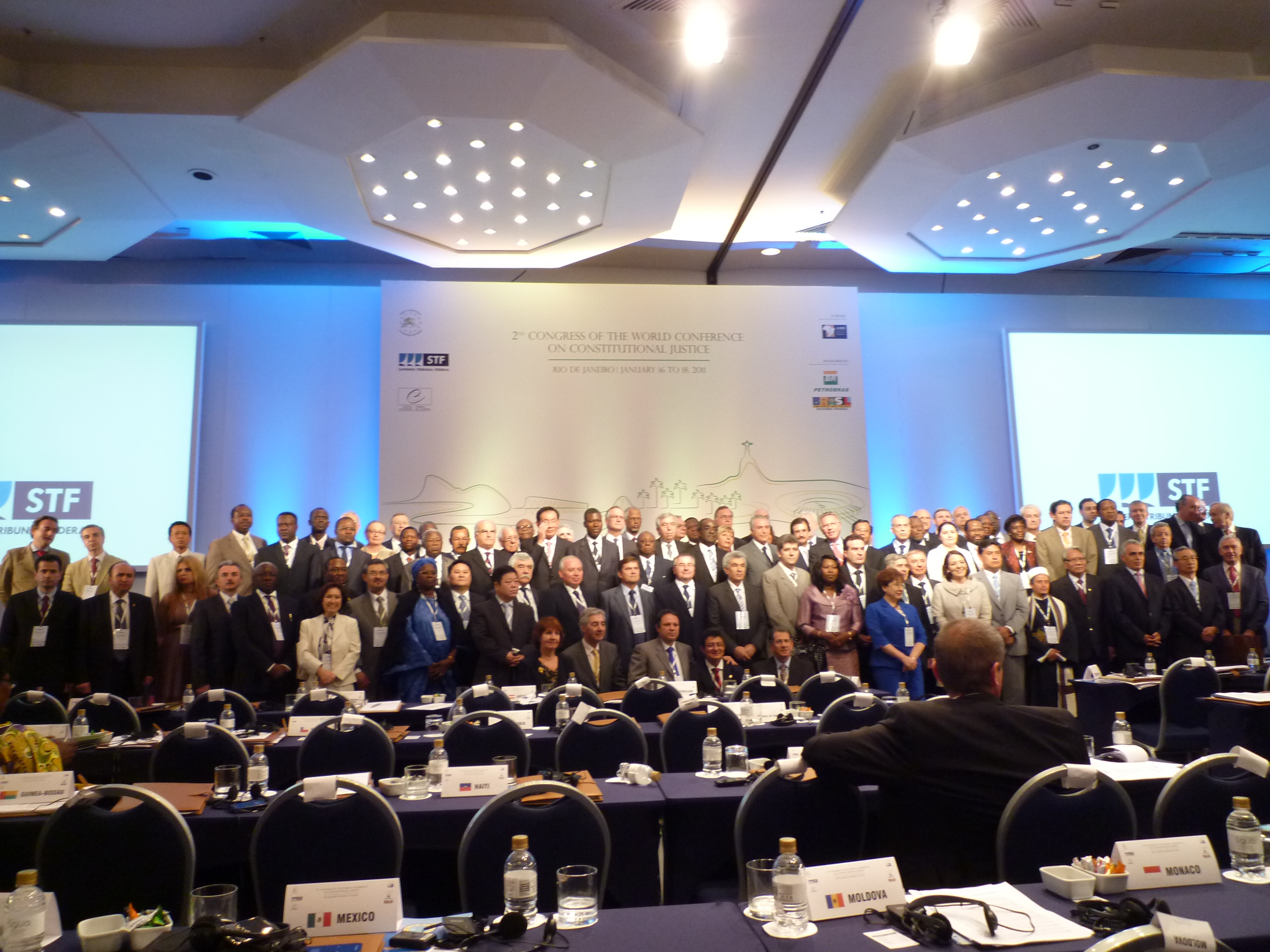
2nd Congress: Rio de Janeiro 2011
|
The World Conference on Constitutional Justice unites
71 Constitutional Courts and Councils and Supreme Courts in Africa, the
Americas, Asia and Europe. It promotes constitutional justice – understood as
constitutional review including human rights case-law – as a key element for
democracy, the protection of human rights and the rule of law (Article 1.2 of
the Statute).
The World Conference pursues its
objectives through the organisation of regular congresses, by participating in
regional conferences and seminars, by promoting experiences and case-law and
by offering good services to members on their request (Article 1.2 of the
Statute).
The main purpose of the World Conference is to facilitate
judicial dialogue between constitutional judges on a global scale. Due to the
obligation of judicial restraint, constitutional judges sometimes have little
occasion to conduct a constructive dialogue on constitutional principles in
their countries. The exchanges that take place between judges from various
parts of the world in the World Conference furthers reflection on arguments,
which promote the basic goals inherent in the national constitutions. Even if
these texts often differ substantially, discussion on the underlying
constitutional concepts unites constitutional judges from various parts of the
world who are committed to promote constitutionality in their own country.
As these judges sometimes find themselves in situations of conflict with
other state powers due to the decisions they had to hand down based on the
Constitution, being part of the World Conference provides them with a forum
that not only allows them to exchange information freely with their peers, but
where judges from other countries can also offer moral support. This can be
important in upholding constitutional principles, which the judges are called
upon to defend in their line of work.
The Courts and Councils, which
are members of and are committed to the principles of the World Conference.
may see their membership suspended by the General Assembly of the World
Conference, in cases of flagrant violation of these principles.
The
following
Courts or Councils have given written notification about their accession to
the Venice Commission, which acts as the Secretariat of the World
Conference (status
7 June 2013):
-
Albania, Constitutional Court
-
Algeria, Constitutional Council
-
Andorra, Constitutional Court
-
Angola, Constitutional Court
-
Armenia, Constitutional Court
-
Austria, Constitutional Court
-
Azerbaijan, Constitutional Court
-
Belarus, Constitutional Court
-
Belgium, Constitutional Court
-
Benin, Constitutional Court
-
Bosnia and Herzegovina
-
Brazil, Federal Supreme Court
-
Bulgaria, Constitutional Court
-
Burkina Faso, Constitutional Council
-
Chad, Constitutional Council
-
Chile, Constitutional Court
-
Congo (Brazzaville), Constitutional Court
-
Congo, Democratic Republic, Supreme Court of Justice
-
Côte d'Ivoire, Constitutional Council
-
Croatia, Constitutional Court
-
Cyprus, Supreme Court
-
Denmark, Supreme Court
-
Egypt, Supreme Constitutional Court
-
Estonia, Supreme Court
-
France, Constitutional Council
-
Gabon, Constitutional Court
-
Georgia, Constitutional Court
-
Germany, Federal Constitutional Court
-
Ghana, Supreme Court
-
Hungary, Constitutional Court
-
Indonesia, Constitutional Court
-
Israel, Supreme Court
-
Italy, Constitutional Court
-
Korea, Republic, Constitutional Court
-
Latvia, Constitutional Court
-
Lithuania, Constitutional Court
-
Lebanon, Constitutional Council
-
Macedonia, Constitutional Court
-
Madagascar, High Constitutional Court
-
Mali, Constitutional Court
-
Mauritania, Constitutional Council
-
Mauritius, Supreme Court
-
Mexico, Supreme Court
-
Moldova, Constitutional Court
-
Mongolia, Constitutional Court
-
Montenegro, Constitutional Court
-
Morocco, Constitutional Council
-
Mozambique, Constitutional Council
-
Netherlands, Council of State
-
Niger, Constitutional Council
-
Norway, Supreme Court
-
Peru, Constitutional Court
-
Pakistan, Supreme Court
-
Poland, Constitutional Tribunal
-
Portugal, Constitutional Court
-
Romania, Constitutional Court
-
Senegal, Constitutional Council
-
Serbia, Constitutional Court
-
Slovakia, Constitutional Court
-
Slovenia, Constitutional Court
-
South Africa, Constitutional
Court
-
Spain,
Constitutional Court
-
Sweden, Supreme Administrative Court
-
Switzerland, Federal Court
-
Tajikistan, Constitutional Court
-
Thailand, Constitutional Court
-
Togo, Constitutional Court
-
Turkey, Constitutional Court
-
Uganda, Supreme Court
-
Ukraine, Constitutional Court
-
Uzbekistan, Constitutional Court
A meeting of the
Bureau of the World Conference will take place in Venice on 15 June 2013.
The 3rd
Congress of the World Conference on Constitutional Justice will be
hosted
by the Constitutional Court of the Republic Korea on 28 September – 1 October 2014.
History
of the World Conference:
Since 1996, the Venice Commission
has established co-operation with a number of regional or language based
groups of constitutional courts, in particular the Conference of European
Constitutional Courts, the Association of Constitutional Courts using the French
Language, the Southern African Judges Commission, the Conference of
Constitutional Control Organs of Countries of New Democracy,
the Association of
Asian
Constitutional
Courts and Equivalent Institutions, the Union of Arab Constitutional Courts and
Councils,
the Ibero-American Conference of Constitutional Justice and the Conference of
Constitutional Jurisdictions of Africa.
In the pursuit of the goal of
uniting these groups and their members, the Commission organised for the first time a Congress of the World Conference on
Constitutional Justice, which was held in Cape Town, South Africa on
23-24 January 2009
hosted by
the Constitutional Court of South
Africa
and which gathered together 9 regional or linguistic groups
and
some 90 courts.
On the basis of a declaration adopted at this occasion, the
Venice Commission assisted a Bureau in the establishment of the World
Conference as a permanent body. At their first meeting in Mexico in April 2009, the Bureau prepared a
draft statute, which was discussed at other meetings of the Bureau on 12
December 2009 and 5 June 2010 in Venice
together with questions of the organisation a second Congress.
Eighty eight Constitutional Courts,
Constitutional Councils and Supreme Courts as well as the 10 regional and
linguistic groups of courts from Africa, the Americas, Asia and Europe
gathered for a 2nd Congress of the World Conference
on Constitutional Justice on the "Separation of Powers and
Independence of Constitutional Courts and Equivalent Bodies" hosted by
the Federal Supreme Court of Brazil in co-operation with the Venice
Commission (Rio de Janeiro, Brazil, 16-18 January 2011).
The draft statute
was amended at this occasion and finally adopted at another meeting of the
Bureau on 23 May 2011 on the occasion of the XVth Congress of the Conference
of European Constitutional Courts.
With the accession of more than 30 Constitutional Courts,
Constitutional Councils and Supreme Courts exercising constitutional justice,
the
Statute of the
World Conference on Constitutional Justice has entered into force
on 24 September 2011.
|