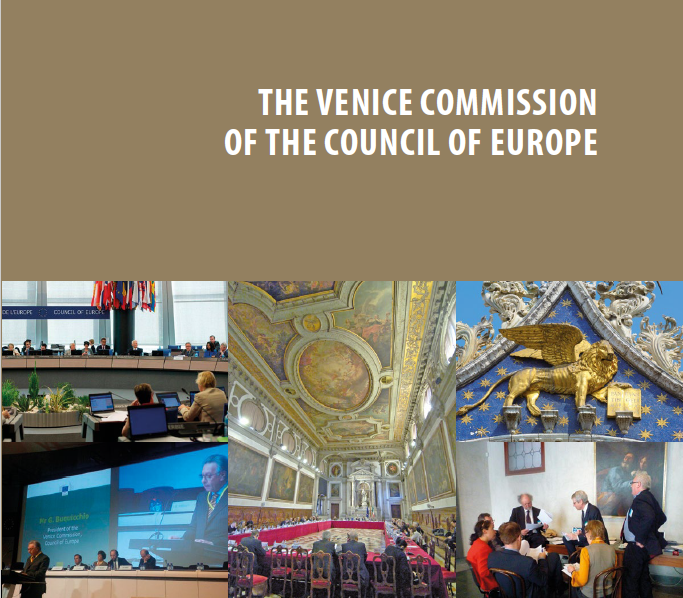
For democracy through law
The European Commission for Democracy through Law - better known as the Venice Commission as it meets in Venice - is the Council of Europe's advisory body on constitutional matters.
The role of the Venice Commission is to provide legal advice to its member states and, in particular, to help states wishing to bring their legal and institutional structures into line with European standards and international experience in the fields of democracy, human rights and the rule of law1.
It also helps to ensure the dissemination and consolidation of a common constitutional heritage, playing a unique role in conflict management, and provides “emergency constitutional aid” to states in transition.
The Commission has 61 member states: the 46 Council of Europe member states2 and 15 other non European members (Algeria, Brazil, Canada, Chile, Costa Rica, Israel, Kazakhstan, the Republic of Korea, Kosovo, Kyrgyzstan, Morocco, Mexico, Peru, Tunisia and the USA). Argentina, Japan, the Holy See and Uruguay are observers. The Committee of Ministers of the Council of Europe auhorised3 cooperation with South Africa and Palestine*. The Commission also cooperates closely with the European Union, OSCE/ODIHR and the Organisation of American States (OAS).
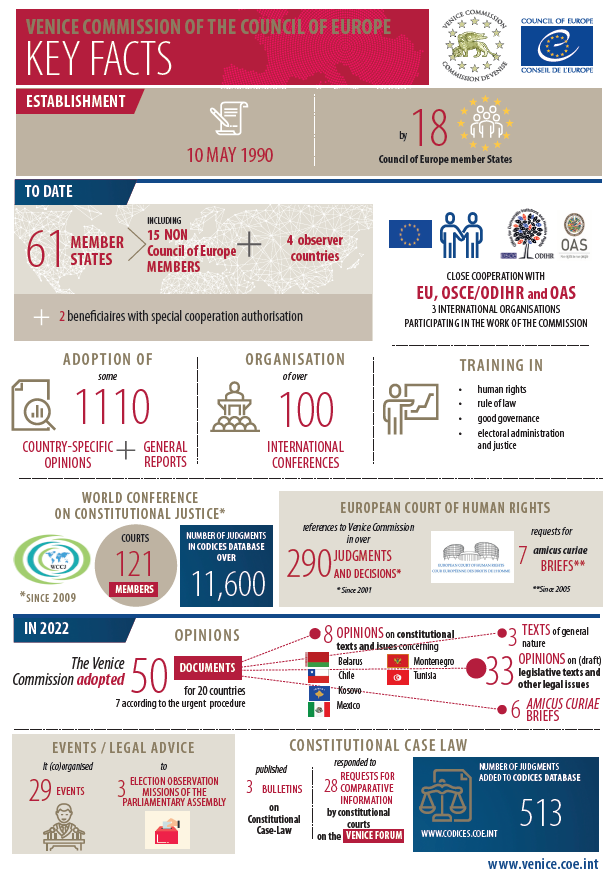
Its individual members are university professors of public and international law, supreme and constitutional court judges, members of national parliaments and a number of civil servants. They are designated for four years by the member states, but act in their individual capacity. Antonio La Pergola, Jan Helgesen and Gianni Buquicchio were the first presidents of the Commission. Since December 2021 this position is held by Claire BAZY MALAURIE.
The Commission works in three areas:
The Commission shares the standards and best practices adopted within the countries of the Council of Europe beyond its borders notably in neighboring countries.
Its permanent secretariat is located in Strasbourg, France, at the headquarters of the Council of Europe. Its plenary sessions are held in Venice, Italy, at the Scuola Grande di San Giovanni Evangelista, four times a year (March, June, October and December).

Useful links:
___________________________________________________________________________________________________
1 Request for opinion may be sent to the President or the Secretary of the Commission by email / fax / post.
2 - Council of Europe has 46 member States (as of 16.03.2022): Albania, Andorra, Armenia, Austria, Azerbaijan, Belgium, Bosnia and Herzegovina, Bulgaria, Croatia, Cyprus, Czechia, Denmark, Estonia, Finland, France, Georgia, Germany, Greece, Hungary, Iceland, Ireland, Italy, Latvia, Liechtenstein, Lithuania, Luxembourg, Malta, Moldova, Monaco, Montenegro, Netherlands, North Macedonia, Norway, Poland, Portugal, Romania, San Marino, Serbia, Slovakia, Slovenia, Spain, Sweden, Switzerland, Türkiye , Ukraine, United Kingdom.
3 - Following a conference on the "Constitutional developments in South Africa", organised in Oslo in April 1993 by the Venice Commission, the Norwegian Ministry of Foreign Affairs and the University of Oslo, all the negotiating partakers in the reconciliation process in South Africa including the South African government, the ANS, the Inkatha Freedom Party and the Democratic Party agreed to involve the Venice Commission in the process. On 14 May 1993, the then Minister of Foreign Affairs of South Africa Mr Botha requested the Secretary General of the Council of Europe, Ms C. Lalumiere, to “approve full cooperation” with the Venice Commission. Consequently, the Committee of Ministers decided to authorise the co-operation between the Commission and South Africa in June 1993.
In April 2008 the then Minister of Justice of Palestine *, Mr Ali Khashan, requested a “special status membership” in the Venice Commission. On 15 May 2008, the Committee of Ministers of the Council of Europe specifically authorised co-operation between the Palestinian National Authority and the Commission. https://search.coe.int/cm/Pages/result_details.aspx?ObjectID=09000016805d3b2f .
Palestine* - This designation shall not be construed as recognition of a State of Palestine and is without prejudice to the individual positions of Council of Europe member States on this issue.